
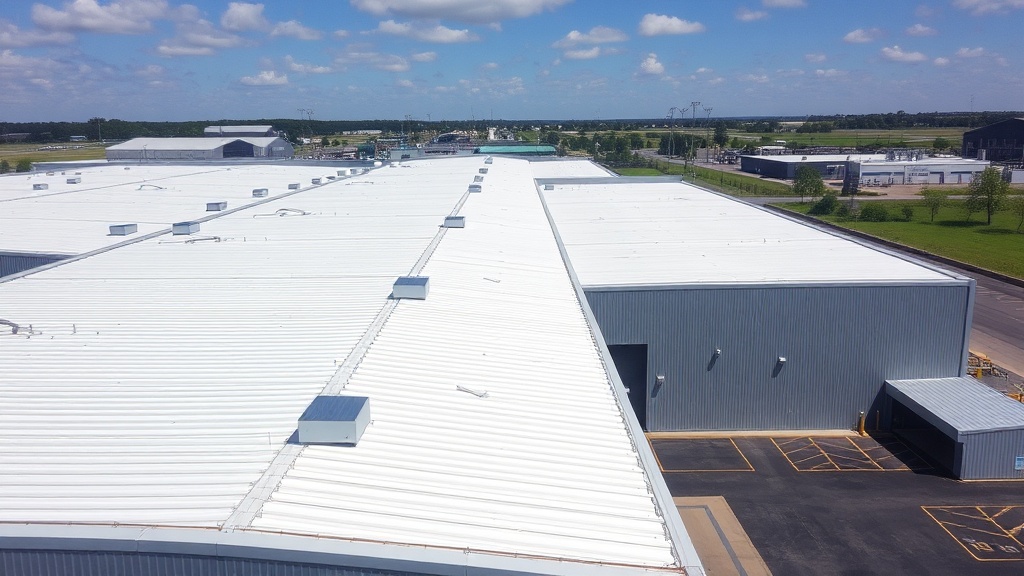
The Quiet Problem That Becomes an Expensive Emergency
A slow roof leak inside a warehouse feels manageable right up until it isn’t. A pallet of electronics gets soaked, a safety inspector flags a sagging ceiling tile, or a worker slips on wet concrete — and suddenly you’re looking at insurance claims, OSHA paperwork, and a repair bill that’s three times what it would have been six months ago.
Commercial roof deterioration rarely announces itself loudly. It builds quietly, hidden above drop ceilings and insulation layers, until the damage crosses a threshold that forces your hand. The five warning signs below are the ones we see most often on CSRA industrial and warehouse properties — and every one of them means the clock is already running.
Sign #1: Interior Water Staining That Keeps Coming Back
Why It’s Worse Than It Looks
A yellow or brown stain on a warehouse ceiling isn’t just cosmetic. By the time moisture has traveled through your roof membrane, insulation, and decking to appear on an interior surface, significant water infiltration has already occurred. The stain you can see represents a fraction of the saturation happening above it.
Saturated insulation loses most of its R-value, which means your HVAC system works harder year-round. On a large warehouse in Augusta, that efficiency loss can add $150–$300 per month to your energy costs — a number that compounds long before anyone calls for a roof repair.
The Mold Timeline You Need to Know
Persistent moisture inside a commercial roof assembly creates mold conditions within 24–72 hours. Once mold colonizes structural wood decking or interior wall cavities, you’re no longer dealing with a roofing problem alone — you’re dealing with an air quality and liability issue that requires remediation before the roof can even be addressed. Mold remediation in a commercial space typically runs $3,000–$15,000 depending on the affected area, and that’s before a single shingle or membrane gets touched.
If a stain reappears after you’ve had it painted or dried out, treat it as an emergency signal. That pattern means active intrusion, not a one-time event.
Sign #2: Membrane Bubbling or Blistering on Your Flat Roof
What’s Actually Happening Under Those Bubbles
Most warehouses in the Augusta area sit under low-slope or flat roofing systems — TPO, EPDM, or modified bitumen membranes. When you walk that roof and notice raised bubbles or blisters in the membrane surface, you’re looking at trapped moisture or gas that has separated the membrane from the substrate beneath it.
Blisters that are left alone don’t stabilize. Georgia’s heat cycles — with summer surface temperatures regularly exceeding 160°F on dark roofing membranes — expand them further each season. Eventually the membrane splits, and what was a contained blister becomes an open entry point for every rainstorm that follows.
When Blistering Means Full Replacement
Small, isolated blisters can often be addressed with targeted warehouse roof repair — cutting, drying, and re-adhering the membrane section. But when blistering covers more than 25% of a roof section, or when the substrate beneath is already compromised, repair becomes a temporary fix on a failing system. An experienced commercial roofing contractor can probe the affected areas and tell you within an hour which scenario you’re in. Do not let a contractor skip the moisture scan — infrared or nuclear testing of the deck is standard practice before any meaningful repair commitment.
Sign #3: Sagging or Deflecting Roof Sections
A warehouse roof that sags or shows visible deflection between structural supports is past the early-warning stage. Sagging indicates that either the decking itself has been compromised by long-term moisture absorption, or the structural load capacity of the system is being exceeded — sometimes both simultaneously.
Steel decking in commercial warehouses is typically designed for specific load ratings. When ponding water (which weighs approximately 5.2 pounds per square foot per inch of depth) sits on a low-slope roof for extended periods, it adds cumulative structural stress that the original design never accounted for. A 20-foot by 20-foot pond of standing water just two inches deep puts over 4,000 pounds of unplanned load on your roof structure.
If you’re seeing interior ceiling deflection, noticing that doors are harder to open or close near the affected section, or watching cracks develop in interior masonry walls, get a structural assessment alongside your roofing evaluation. What looks like a roofing issue may also involve the building frame.
Sign #4: Drainage Failures and Chronic Ponding Water
The 48-Hour Rule for Flat Roofs
Commercial roofing standards are clear on this: water should not remain on a flat or low-slope roof more than 48 hours after a rain event. If your warehouse roof holds water longer than that routinely, your drainage system is failing — whether from clogged interior drains, deteriorated scuppers, or a roof surface that has settled and lost its designed slope.
Ponding water is particularly destructive to membrane systems. It accelerates UV degradation, promotes algae and vegetation growth that can physically penetrate the membrane, and creates freeze-thaw stress in winter months that widens any existing cracks. Industrial properties along the Savannah River corridor deal with heavy summer rain events regularly, and a drainage system that can’t handle Augusta’s typical 3–4 inch single-storm events is a liability waiting to materialize.
Drainage Fixes That Aren’t Actually Fixes
One mistake we see repeatedly on older CSRA warehouse properties: someone cleans out the drains, the ponding improves temporarily, and the roof gets ignored again. Drain maintenance is necessary, but it doesn’t address a roof deck that has deflected and created permanent low spots, or scuppers that have corroded and narrowed. A camera inspection of internal drain lines and a slope evaluation with a level across multiple reference points will tell you whether cleaning solved the problem or just delayed the conversation.
Sign #5: Visible Seam Failures and Flashing Separation
Roof seams and flashings — the metal terminations at walls, curbs, HVAC equipment, and penetrations — are statistically the most common source of commercial roof leaks. They’re also the most preventable, which makes finding separated or lifted flashing on a warehouse a frustrating sign, because it usually means routine maintenance hasn’t been happening.
On membrane systems, seam adhesion breaks down from thermal cycling and UV exposure over time. On metal roofing systems, fastener corrosion allows panels to separate at the laps. Either way, an open seam during a 2-inch Augusta rainstorm can deliver hundreds of gallons of water into your building within minutes — damage that happens faster than most facilities managers realize until they’re looking at soaked inventory.
If your warehouse uses a standing seam metal roof, pay particular attention to the condition of the ridge cap and any field-cut penetrations. These are the locations where field errors and age-related failures cluster first. A proper warehouse roof repair in these areas is relatively inexpensive when caught early — often $800–$2,500 for isolated flashing work — but ignored flashing failures routinely lead to interior damage claims that run five to ten times that amount.
How Delayed Repairs Compound Your Costs and Liability
Every commercial property manager has faced the budget pressure of deferring maintenance. Roofing rarely feels urgent until it is. But the math on deferred commercial roof repair in Augusta is straightforward: a repair that costs $3,000–$6,000 today typically costs $12,000–$25,000 after two more seasons of water infiltration have damaged decking, insulation, and interior systems. That’s before factoring in inventory loss, business interruption, or OSHA liability if a worker is injured in a documented water intrusion area.
Insurance carriers are also paying closer attention to maintenance records on commercial properties. A claim filed after years of documented but unaddressed roof deterioration can be partially or fully denied based on negligent maintenance. Keeping dated inspection records and completing repairs promptly creates documented due diligence that protects your claim.
If your situation has already reached the point where water is actively entering the building, emergency roof repair is the right first call — stopping active intrusion before a longer-term fix is planned and quoted. Temporary waterproofing measures like applied coatings or tarp systems can stabilize a failing area while a permanent repair scope is developed.
What to Do Right Now If You’ve Spotted Any of These Signs
Walk your roof — or have someone qualified walk it — at least twice a year, and always after major storm events. Document what you find with dated photographs stored in a property maintenance file. If you’re searching for roof leak repair near me or reaching out to roofing repair companies for the first time, look for contractors who perform moisture scans and written assessments rather than verbal estimates alone. A written scope protects both parties and gives you a benchmark for future inspections.
Hixons Roofing has served commercial property owners across Augusta and the broader CSRA for years, completing warehouse assessments, targeted membrane repairs, and full commercial roof replacements across the region’s industrial corridor. We know what Augusta’s climate does to flat roofing systems over time, and we bring that field knowledge to every assessment we perform.
Stopping one of these five warning signs early rarely costs more than a few thousand dollars. Waiting until all five are present can mean a complete system replacement in the $40,000–$120,000 range depending on building size — plus the costs of everything that failed inside.
If the roof over your warehouse is showing any of these patterns, get eyes on it before the next storm season makes the conversation much harder.
Written by the Hixons Roofing team — commercial roofing specialists serving Augusta-area industrial and warehouse properties with hands-on expertise in flat roof repair, membrane systems, and metal roofing.
Schedule a commercial roof assessment with Hixons Roofing at hixonsroofing.com.