
Your Roof Is Aging Faster Than the Warranty Says
A standard asphalt shingle carries a 25- or 30-year warranty. That number was calculated for inland conditions — not for the salt-laden air that rolls off the Atlantic and settles on every surface from downtown Charleston to the neighborhoods of Mount Pleasant. In coastal South Carolina, that same shingle realistically performs for 15 to 20 years before significant degradation sets in, sometimes less depending on roof pitch, tree coverage, and proximity to open water.
That gap between printed warranty and real-world lifespan is one of the most expensive surprises homeowners face — and it almost never gets explained at the point of sale. Understanding exactly how salt air does its damage is the first step toward protecting one of the biggest investments your home represents.
What Salt Air Actually Does to Your Shingles
The Granule Problem Nobody Talks About
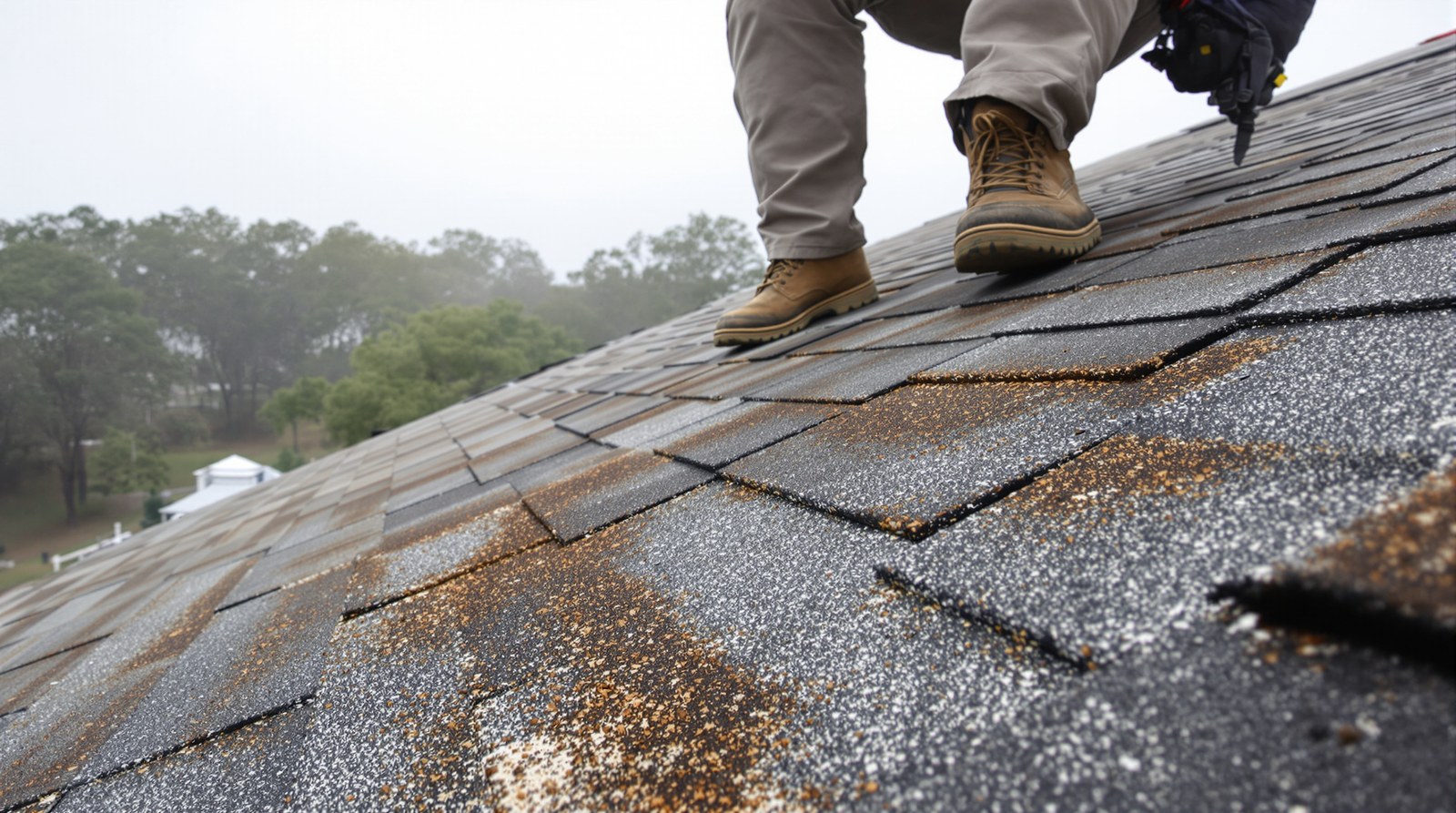
Asphalt shingles rely on a dense layer of ceramic-coated granules to block UV radiation and shed water. Salt air disrupts this in two ways. First, airborne salt particles are abrasive at a microscopic level — they gradually dislodge granules over time, especially on south- and west-facing slopes that see the most wind-driven exposure. Second, salt is hygroscopic, meaning it draws and holds moisture. That trapped moisture works under the granule adhesive layer, loosening the bond between granules and the asphalt mat beneath them.
Once granule loss accelerates, UV degradation follows quickly. The asphalt itself oxidizes, becomes brittle, and starts cracking. What started as a cosmetic issue — a little extra granule sediment in your gutters — becomes a waterproofing failure within a few seasons. On homes we’ve inspected across the Charleston area, we’ve seen 12-year-old shingles with granule loss patterns that would typically take 20-plus years to develop inland.
How Salt Destroys the Mat Beneath
The fiberglass or organic mat that forms the structural backbone of an asphalt shingle is not immune to salt exposure either. Salt particles that penetrate through granule gaps introduce chlorides into the mat, which weaken the fibers and reduce the shingle’s ability to handle foot traffic or minor impact — the kind of minor impact that comes from every storm that rolls through the Lowcountry between June and November.
A shingle weakened at the mat level looks fine from the ground. You’d need to get on the roof and flex a tab with your hand to feel the brittleness. That’s one reason coastal roofing inspections should happen more frequently — every two to three years rather than every five — and why a drive-by visual check is never enough in this climate.
Coastal Roofing Charleston: The Metal Problem Is Worse Than You Think
When Fasteners Fail First
Roofing systems are held together by hundreds of fasteners — nails, screws, and staples that anchor shingles, flashing, ridge caps, and underlayment. In coastal South Carolina, those fasteners face a threat that inland homeowners simply don’t deal with at the same scale: galvanic corrosion accelerated by salt air.
Standard galvanized roofing nails are zinc-coated to resist rust. But salt air strips that protective zinc coating dramatically faster than dry inland air. Once the zinc layer is compromised, the underlying steel corrodes. A fastener that would last 30 years inland may show significant corrosion in 8 to 12 years near the coast. When fasteners corrode, shingles and flashing lose their mechanical hold — and the next Category 1 wind event does the rest of the work.
The fix isn’t complicated, but it costs more upfront: stainless steel or hot-dipped galvanized fasteners rated for coastal exposure should be specified on every residential roof installation within 15 miles of the ocean. Many budget installations skip this step. It’s a decision that looks fine for the first few years and catastrophic after the first serious storm.
Flashing: The Most Vulnerable Point on a Coastal Roof
Roof flashing — the metal strips that seal joints around chimneys, skylights, valleys, and wall transitions — is chronically underestimated as a failure point. Standard aluminum flashing corrodes in salt air environments. We’ve removed aluminum flashing from Charleston homes that was 30% thinner than its original gauge due to corrosion, with pinhole leaks developing along the edges where the metal met mortar or caulk.
Galvanized steel flashing fares somewhat better but isn’t the right answer for coastal roofing in Charleston either. The genuine solution is copper or lead-coated copper flashing, which is naturally resistant to salt-driven corrosion and lasts 50 or more years in coastal conditions. The tradeoff is cost — copper flashing runs roughly $25 to $45 per linear foot installed, compared to $8 to $15 for aluminum. For a chimney with 20 linear feet of flashing, that’s a price difference of $340 to $600. Spread over 30 extra years of service life, it’s not a close call.
Why Salt Air Doesn’t Just Attack the Top of Your Roof
Soffit, Fascia, and Gutter Corrosion
Salt air doesn’t stop at the shingles. It infiltrates soffits, attacks painted fascia boards, and corrodes the hardware that holds gutters to the roofline. Standard steel gutter hangers and spikes can rust through in five to eight years in coastal environments, causing gutters to pull away from the fascia — which then allows water to infiltrate behind the gutter and into the fascia board itself.
Seamless aluminum gutters with stainless steel hidden hangers perform significantly better in this environment. If your gutters are more than a decade old and you’re in the Charleston area, it’s worth having them evaluated at the same time as your roof. A failing gutter system can direct water into your eaves and attic just as effectively as a failing roof membrane.
The Attic Moisture Cycle You Don’t See
Salt-laden coastal air also contains more moisture than inland air — that’s just the physics of proximity to the ocean. This elevated ambient humidity means your attic sees more moisture cycling through it year-round, which accelerates the degradation of decking, insulation, and roof system components from beneath. A roof that is watertight from above can still develop mold, rot, and structural weakening from inadequate attic ventilation in a coastal climate.
Proper ridge and soffit ventilation isn’t optional in Lowcountry residential roofing — it’s a requirement if you want your decking and structural members to match the lifespan of the new surface materials above them.
Roofing Materials That Actually Hold Up on the Coast
Metal Roofing: The Strongest Argument
Standing seam metal roofing is the most defensible choice for coastal South Carolina homes. A properly installed Kynar 500 or PVDF-coated steel or aluminum standing seam roof resists salt air corrosion, sheds wind-driven rain effectively, and carries manufacturer warranties of 40 years or more. Unlike asphalt, metal doesn’t have granules to lose or mats to weaken. The coating is the protection layer, and modern fluoropolymer coatings are remarkably resistant to the chloride exposure that coastal air delivers.
Hixons Roofing installs standing seam metal roofing throughout the Lowcountry, and in our experience, it consistently outperforms other roofing materials in coastal conditions when properly detailed at every penetration and seam. The upfront investment typically runs $18,000 to $32,000 for a residential installation depending on roof complexity, versus $9,000 to $16,000 for a quality architectural shingle job. But on a coast-adjacent home where asphalt shingles realistically need replacement every 15 to 18 years, the math over a 40-year period often favors metal substantially.
Architectural Shingles: Choosing the Right Grade
If asphalt is the right fit for your budget or home style, the grade of shingle matters significantly more in coastal conditions than it does inland. Impact-resistant Class 4 shingles with a heavier fiberglass mat and enhanced granule adhesion hold up better to both storm impact and salt abrasion. Look specifically for products rated to ASTM D3161 Class F wind resistance and with granules containing algae-resistant copper granules — coastal humidity means algae and moss are as much a threat as salt itself.
Avoid the temptation to match what your neighbor used or simply choose the least expensive option. A shingle that costs $150 more per square installed could easily represent the difference between a 14-year lifespan and a 20-year lifespan in this climate.
Protective Coatings for Existing Roofs
For roofs that are still structurally sound but showing early signs of salt air roof damage, elastomeric roof coatings can extend service life meaningfully. These coatings — applied by licensed residential roofing contractors — seal minor cracks, improve reflectivity, and add a moisture barrier that slows granule degradation. They’re not a substitute for replacement when a roof is genuinely at end of life, but on a 10-year-old roof in decent condition, a quality coating application in the $2,500 to $5,500 range for a typical home can add five to eight years of serviceable life.
How Often Coastal Roofs Need Professional Inspection
A coastal roof inspection isn’t the same exercise as one done on an inland home. It requires getting on the surface, checking fastener heads for rust bleed, testing flashing edges for pitting and thinning, and examining the underside of eaves for moisture intrusion signs. Drive-by or aerial drone assessments miss the details that determine whether a roof has two good years left or eight.
For homes in North Charleston and the broader Lowcountry, we recommend professional inspections every two to three years for roofs under 15 years old, and annually for roofs older than that. After any named storm or significant wind event, an inspection within 30 days is prudent — coastal salt air roof damage doesn’t just come from slow atmospheric exposure. A storm that lifts a few shingle tabs and exposes the mat underneath turns a slow problem into a fast one.
Your roof is the only thing standing between the Lowcountry’s humidity, salt wind, and storm seasons and the inside of your home. Treat inspections as maintenance, not emergency response.
Written by the Hixons Roofing team — experienced residential roofing contractors serving Charleston and the South Carolina Lowcountry, with deep field knowledge of coastal roofing installation and storm damage repair.
For an honest assessment of how salt air has affected your specific roof, schedule an inspection with Hixons Roofing at hixonsroofing.com.