
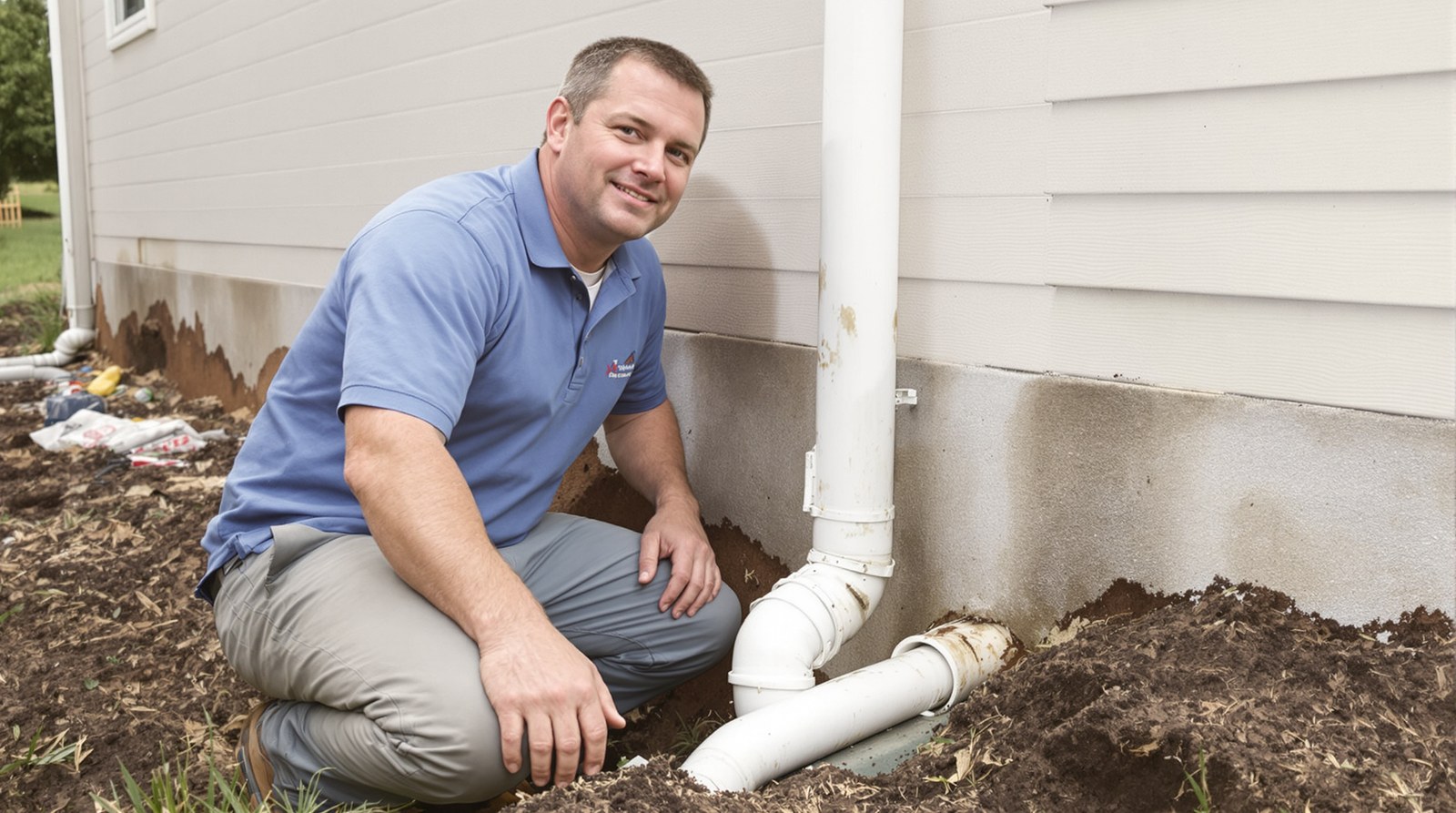
Your Roof Sheds Thousands of Gallons — Where Does It All Go?
A 1,500-square-foot roof sheds roughly 900 gallons of water during a single inch of rainfall. That’s not an estimate pulled from a textbook — it’s basic hydrology: one inch of rain across one square foot of roof produces 0.6 gallons of runoff. Do that math across your entire home, and you’re dealing with a small flood every time a storm rolls through Augusta.
The question isn’t whether that water is a threat. It’s whether your downspouts are sending it somewhere safe — or straight into your foundation.
Most homeowners think about gutters when they notice overflow during a storm. Far fewer think about where the water goes after it enters the downspout. That gap in attention is exactly where foundation damage begins.
What Proper Downspout Installation Actually Prevents
A downspout’s job isn’t just to move water off the roof. Its real job is to deposit that water far enough away from your home that the soil around your foundation stays stable. The standard minimum is six feet from the foundation wall — but on CSRA clay soils, that number often isn’t enough.
The Clay Soil Problem That Makes the CSRA Different
The Aiken-Augusta corridor sits on some of the most water-reactive clay soil in the Southeast. Cecil and Appling clay series — common throughout the CSRA — expand significantly when saturated and contract when dry. That cyclical swelling and shrinking is called clay heave, and it’s one of the leading causes of foundation cracks in this region.
When a downspout deposits water within two or three feet of your foundation, that clay goes through wet-dry cycles repeatedly, season after season. Each cycle puts lateral pressure on your foundation walls. Over five to ten years, that pressure shows up as stair-step cracks in brick, bowing basement walls, or doors that suddenly won’t close properly — all traced back to water management that was never right to begin with.
Proper downspout installation in the CSRA means accounting for clay behavior, not just standard drainage guidelines written for regions with sandier soils.
The Discharge Distance That Most Installers Get Wrong
Industry guidance from the International Residential Code suggests downspout extensions should discharge water at least six feet from the foundation. On reactive clay, experienced contractors often recommend ten to twelve feet, particularly on the uphill side of a sloped lot. We’ve seen homes in Beech Island where a six-foot extension was completely overwhelmed because the yard’s natural grade funneled the discharged water right back toward the house.
The slope of your yard matters as much as the length of the extension. A four-degree grade toward the foundation can undo a six-foot extension entirely during a heavy rain. Splash blocks help, but they’re not a substitute for getting the discharge direction right from the start.
Four Ways a Bad Downspout Destroys More Than Your Foundation
Basement Moisture and Crawlspace Humidity
Water that saturates soil near your foundation doesn’t just push on walls — it wicks through them. Poured concrete and block foundations are porous. When the surrounding soil holds moisture from repeated short-circuit downspout discharge, interior humidity climbs, vapor barriers fail, and mold finds a foothold. Crawlspace remediation in Augusta typically runs $3,000 to $8,000 depending on scope. Correct downspout installation costs a fraction of that.
Landscape Erosion That Compounds Every Season
A downspout dumping onto bare soil without a proper extension or splash block can erode a surprising amount of ground in a single season. We’ve walked properties in the CSRA where a two-year-old downspout had carved a channel eight inches deep along the foundation line. That eroded channel then becomes a natural path for water to pool directly against the house — the opposite of what any drainage system should do.
Driveway and Walkway Undermining
Concrete and pavers need stable, compacted subbase to hold their shape. When a downspout discharges near a driveway edge or a sidewalk, repeated saturation loosens that subbase. Slabs crack. Pavers sink. The repair bill for a sunken driveway section typically starts around $1,500 — and the culprit is almost never identified as the downspout six feet away.
Saturated Planting Beds That Kill Landscaping
Ornamental beds positioned near downspout discharge points get hammered by concentrated flow. Even drought-tolerant plants can’t survive roots sitting in water-logged clay for days after every storm. Homeowners replace plants season after season without realizing a single downspout relocation would solve the problem permanently.
Clogged and Disconnected Downspouts: Worse Than No System At All
A clogged downspout is deceptive — the gutters look fine from the street, the system appears intact, but water is backing up and finding the path of least resistance. That path is usually behind the fascia board, into the soffit, and down the exterior wall. By the time staining appears on the siding, wood rot has often been progressing for months.
Disconnected downspout sections — a common failure point at the elbow joints near the foundation — are even more dangerous because the discharge happens at the base of the wall rather than away from it. The joint pops loose from wind, freeze-thaw cycles, or simple age, and suddenly your downspout is depositing water exactly where you least want it.
Routine gutter repair that includes downspout inspection catches these failures before they become foundation problems. The cost of resealing a joint or replacing a section of downspout pipe runs $75 to $200. The cost of a foundation repair contractor in South Carolina starts around $5,000 and goes up fast depending on severity.
Signs Your Downspouts Are Already Causing Damage
You don’t need to hire an inspector to spot early warning signs. Walk your property during or immediately after a heavy rain and look for these specific indicators:
- Water pooling within four feet of the foundation after the rain stops — a sign that discharge is too close or soil grading has reversed toward the house.
- Staining, efflorescence (white salt deposits), or damp spots on basement or crawlspace walls — indicating moisture is wicking through from saturated exterior soil.
- Soil that has pulled away from the foundation in a gap or depression — classic erosion from concentrated downspout discharge.
- Gutters overflowing at mid-span rather than at corners — often signals a clogged downspout, not a gutter capacity problem.
Any one of these signs warrants a closer look at your entire drainage system, not just the visible gutter sections.
What Good Downspout Installation Looks Like in Practice
Sizing That Matches Your Roof Load
Standard residential downspouts are three inches by four inches for rectangular profiles, or three to four inches in diameter for round. On larger roofs — anything above 1,200 square feet per drainage zone — undersized downspouts back up during heavy rain events, forcing water over the gutter edge. Proper downspout installation starts with a drainage calculation, not a guess based on what’s already on the house.
Extensions, Drains, and Grade Correction
Rigid extensions work well on flat or gently sloping lots. On lots with more complex grading, corrugated flexible extensions often get used as a shortcut — but they kink, clog with debris, and trap standing water. Buried pop-up drains or French drain tie-ins are the right answer when terrain makes surface extensions impractical. They cost more upfront — typically $400 to $900 per downspout connection — but they eliminate the surface discharge problem entirely.
Pairing Downspout Work with Gutter Repair
Gutter installation and roofing work exist on the same system. A roof that sheds water efficiently into gutters that are pitched correctly, free of debris, and connected to properly placed downspouts functions as a unified drainage network. When one component fails, the others compensate poorly. Hixons Roofing approaches downspout and gutter work as part of a whole-roof evaluation — because a repaired downspout on a sagging gutter section just moves the failure point six feet down the line.
Roof Maintenance Connects Here Too
Roof maintenance for homeowners often gets treated as a separate category from drainage work, but the connection is direct. Damaged flashing, missing drip edge, or deteriorated shingles all affect where water enters the gutter system and how much debris ends up in downspouts. Downspouts clogged with granule loss from aging shingles are a signal that the roof itself needs attention. Address both together and you close the entire loop.
The Cost of Doing Nothing
Foundation repair in South Carolina is expensive precisely because the CSRA’s clay soil amplifies water damage faster than most homeowners expect. A structural engineer’s assessment alone typically runs $300 to $600. Actual remediation — pier systems, wall anchors, waterproofing — commonly falls in the $8,000 to $25,000 range depending on how far the damage has progressed.
Correct downspout installation across a typical home runs $600 to $1,500, including extensions or minor grade correction. Gutter repair that catches a disconnected section or clears a chronic clog is usually under $300. The math isn’t subtle.
Roof repair for homes that have suffered water intrusion tied to drainage failures adds another layer of cost that compounds quickly. When water has been backing up behind fascia for two seasons, the repair scope expands well beyond the gutter system into decking, insulation, and interior finishes.
Fix the downspouts before the foundation tells you to.
Written by the Hixons Roofing team — experienced roofing and gutter specialists serving the CSRA and surrounding South Carolina communities.
To schedule a drainage inspection or get a quote on downspout installation for your home, contact Hixons Roofing at hixonsroofing.com.