
The Small Mistake That Causes a Costly Roof Repair
A single staple through an asphalt shingle tab doesn’t look like much. But that tiny puncture — multiplied by the dozens of fasteners a typical holiday light run requires — creates entry points for water, lifts the adhesive seal between shingles, and can void your roofing warranty. It’s a pattern that tends to show up in January and February, right after the decorations come down.
Hanging Christmas lights on your roof is completely doable without leaving a mark. You just need to know which surfaces to avoid, which clips actually work, and when to keep both feet firmly on the ground.
Why Holiday Lights Are Harder on Roofs Than You Think
Asphalt shingles are tougher than they look in some ways and more fragile than you’d expect in others. The granule surface sheds water beautifully — but it’s not designed to be walked on, pierced, or held under pressure by a staple or nail. Each shingle is factory-sealed with an asphalt adhesive strip that bonds one course to the next. Drive a staple through that strip and you’ve broken the seal. Water finds that break faster than you’d imagine.
Gutters are even more vulnerable. Standard aluminum gutters are typically around 0.027 inches thick — thin enough that the wrong clip, overtightened or repeatedly removed, can deform the front lip and cause the gutter to pull away from the fascia over time. A gutter that’s sagging even half an inch loses its drainage slope and starts holding standing water.
The Specific Spots That Cause the Most Damage
Flashing — the metal strips that seal your roof around chimneys, dormers, skylights, and valleys — is non-negotiable. Never attach lights or any fastener to flashing. It’s a thin metal sheet that relies on a tight, undisturbed fit to keep water out. Even small bends or lifted edges from a clip can send water straight into your attic.
Ridge vents are another hard no. These run along the peak of your roof and are engineered to allow attic airflow. Any weight, pressure, or penetration along the ridge can compress or misalign the vent material and affect your attic’s thermal balance.
Shingle tabs — the exposed lower portion of each individual shingle — are where most DIY damage happens. This is exactly where people want to clip lights. It’s accessible, it looks clean, and it’s tempting. But those tabs are the thinnest part of the shingle, and they’re under constant expansion and contraction stress from temperature swings. Forcing a staple or gutter nail through them adds a stress point that cracks over time.
Safe Christmas Light Clips for Shingles and Gutters
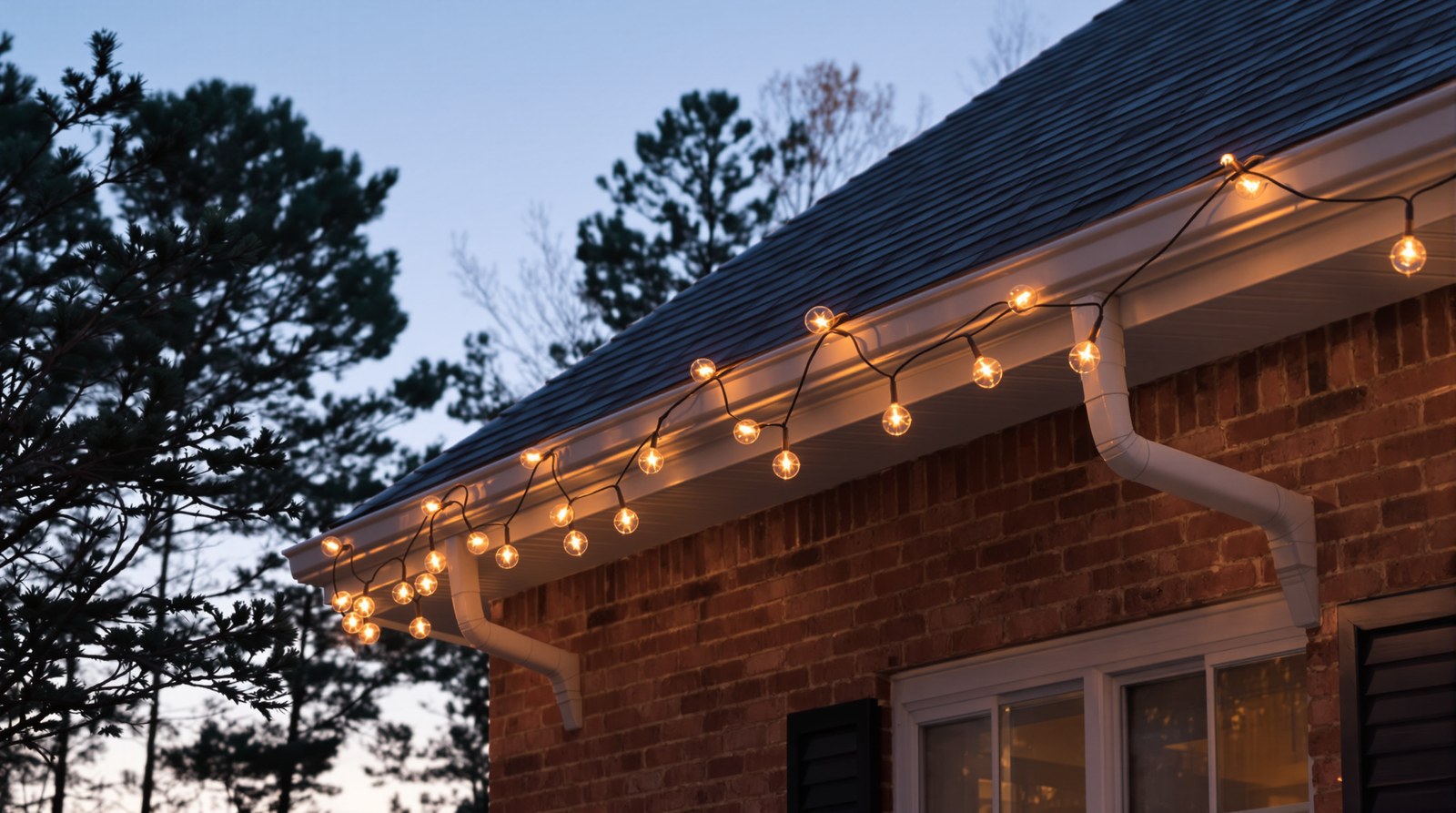
The roofing and holiday lighting industry has converged on a genuinely good solution: plastic all-in-one light clips designed to slide over the shingle’s lower edge without any penetration. These hold the light strand against the fascia line or along the roof edge without touching the adhesive strip or puncturing anything. You can find them at any big-box home improvement store for a few dollars per pack of 50.
For gutters specifically, look for clips that hook over the outer lip of the gutter — not into the gutter itself. The hook-style gutter clip distributes pressure across the gutter’s lip rather than concentrating it at a single grip point, which is what causes deformation.
What to Use on a Metal Roof
Metal roofing — including standing seam panels — requires a completely different approach. You cannot use standard shingle clips on a metal roof. The panels move significantly with temperature changes, and any rigid attachment point can scratch the coating, create galvanic corrosion if the wrong metals contact each other, or damage the panel seams.
For standing seam metal roofs, magnetic clips or non-penetrating seam clips designed specifically for metal panels are the right tool. Magnetic clips attach to the flat field of the panel without touching the seam. Seam-specific clips snap onto the raised seam itself with no adhesive or puncture required. This matters especially in the Augusta area, where residential metal roofing has become increasingly popular for its longevity and energy efficiency — you don’t want to compromise a 50-year roof over a strand of lights.
When You Should Not Be on That Roof at All
No holiday light display is worth a fall. Roof pitch, surface condition, and time of day all determine whether going up is a reasonable call or a dangerous one.
If your roof pitch is steeper than a 6:12 — meaning it rises 6 inches for every 12 inches of horizontal run — you’re in territory that requires specialized footing and safety equipment to work safely. Most Aiken-area ranch homes and bungalows sit in the 4:12 to 6:12 range, which is manageable for a careful adult with a stable ladder. Two-story homes with steeper gabled roofs are a different conversation entirely.
The Morning Frost Problem Nobody Talks About
South Carolina gets frost more reliably than people from outside the region expect. November and December mornings in the CSRA can drop to the upper 20s, and a frost-covered roof — whether asphalt or metal — has zero traction. It doesn’t look slippery from the ground. That’s the problem. Roofers who’ve worked this area for years have a simple rule: if the temperature was below 35°F overnight, stay off the roof until midday, full stop.
Wet roofs after rain are equally treacherous. Algae and moss — common on older shingles in the humid Southeast — become near-frictionless when wet. If your roof has any dark streaking along the shingle surface, that’s biological growth, and it turns slick in a hurry.
Use the Ladder, Skip the Roof Walk
For most single-story homes, you can hang lights along the entire roofline without ever stepping onto the roof. A quality extension ladder, properly footed and angled at roughly 75 degrees, gets you to the eave. Work from the ladder, move it methodically, and use a clip tool (a simple plastic hook that extends your reach) to place clips without overextending. The goal is to never reach more than an arm’s length to either side — that’s when ladder falls happen.
Taking Lights Down in January Without Tearing Shingles
January removal is actually where more shingle damage occurs than during installation. Cold weather makes asphalt shingles brittle. Shingles that flexed fine in October become stiff and prone to cracking when temperatures drop into the 30s. Yanking a clip free in January — especially one that’s been frozen in place — can crack a shingle tab or pull the granule surface clean off.
The fix is simple: remove lights on a mild afternoon when temperatures are above 45°F and the sun has been on the roof for a few hours. Warm shingles flex. Cold shingles crack. If the light strands have frozen to the shingle surface at any point, use your palm to gently warm the contact area before pulling the clip free.
Remove clips in the same direction they were installed — against the direction of removal, they act like a lever on the shingle edge. Slide them out parallel to the shingle surface rather than pulling straight outward.
The Post-Holiday Roof Check Every Homeowner Should Do
Once the lights are down and stored, take 15 minutes to do a visual inspection from the ground with a pair of binoculars. You’re looking for four things: lifted shingle tabs, cracked or missing granules, any flashing that looks bent or separated, and gutter sections that appear to have shifted or are sagging.
The post-holiday check matters because a small issue that existed before December often only gets noticed in January, when the lights come down. A cracked tab that was hidden under a light strand. A gutter section that was already pulling away and got finished off by the extra clip weight.
Catching those issues in January means a minor repair. Missing them through spring means water infiltration, decking rot, and a significantly larger job.
- Lifted or curling shingle tabs along the eave line indicate adhesive failure — a repair job, not a replacement, if caught early.
- Dark water staining on fascia boards below the gutter suggests overflow caused by a sagging or clogged gutter section.
- Rust streaks below metal flashing mean the flashing has been disturbed and water is tracking where it shouldn’t.
- Any soft or spongy feeling underfoot near the eave edge — if you do walk the low slope — signals decking moisture damage.
Roof maintenance for homeowners doesn’t have to be complicated. A twice-yearly look — spring and post-holiday — catches the issues that turn into expensive problems if ignored.
A Few Final Thoughts Before You Plug In This Year
Hanging Christmas lights on your roof safely comes down to three habits: use the right clips for your roof type, stay off steep or slick surfaces, and remove everything on a warm afternoon in January. Those three things prevent the vast majority of holiday-related roof damage we see in the field.
If you do spot lifted or cracked shingles after your lights come down this season, that’s not a wait-and-see situation — it’s a call to make before the spring rains arrive.
Written by the Hixons Roofing team — experienced roofing specialists serving residential and commercial customers across the Aiken and Augusta area, with deep field knowledge in asphalt shingle roofing, metal roofing installation, and storm damage repair.
If your post-holiday inspection turns up cracked shingles, lifted flashing, or anything that doesn’t look right, Hixons Roofing can take care of it. See our roof repair services or contact us to schedule an inspection.