
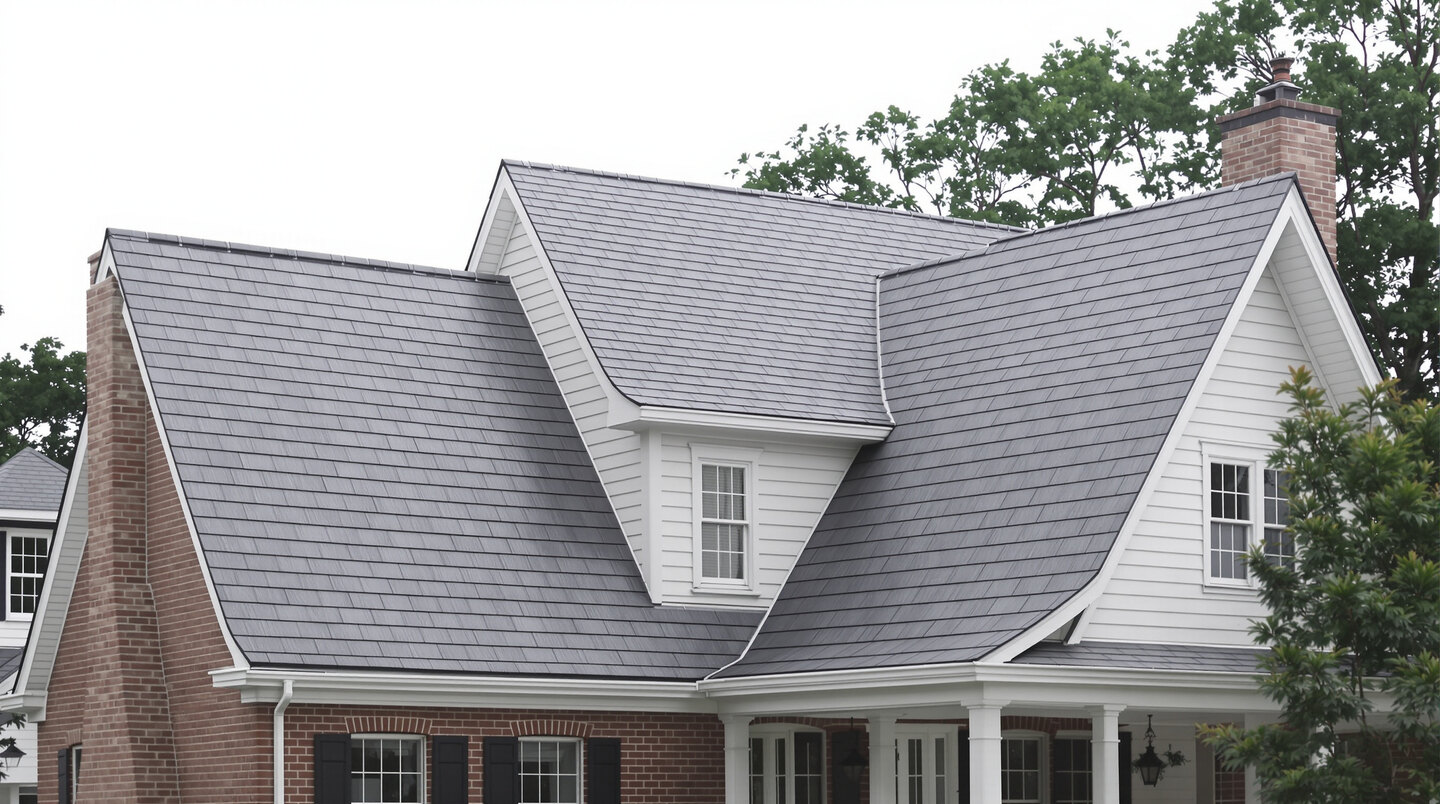
The Roof That Looks a Million Dollars Without Costing It
A genuine slate roof on a historic Charleston single-house is a sight to stop traffic. That layered, dimensional texture — the way it catches afternoon light differently than any other roofing material — has no real equal. But the moment a roofing contractor quotes you $60,000 to $100,000 for a full slate installation on a 2,000-square-foot home, the aesthetic appreciation tends to fade fast.
That price gap is exactly why synthetic slate roofing has become one of the most requested residential roofing options we field in the Charleston and Mount Pleasant markets. Homeowners in established neighborhoods want that traditional look. They just don’t want the structural engineering fees, the quarrying costs, or the repair bills that come with real stone on a roof.
The question worth asking isn’t whether synthetic slate looks as good as natural slate. The better question is: once it’s installed and you’re standing on the street, can you actually tell the difference?
What Synthetic Slate Is Actually Made Of
The Material Behind the Mimicry
Synthetic slate tiles are manufactured from a blend of recycled rubber, plastic polymers, and sometimes fiberglass or cellulose fiber. The exact composition varies by manufacturer and product line, but the goal is consistent: replicate the visual profile and texture of quarried slate while eliminating the weight and brittleness.
High-quality synthetic slate products are compression-molded from actual slate samples, which is why the surface texture reads as genuinely convincing rather than plastic-looking. The tiles arrive pre-colored with UV-stabilized pigments, meaning the color doesn’t live only on a surface coating — it runs through the material. That matters for long-term appearance, especially in South Carolina’s intense sun exposure.
How It Compares to Natural Slate and Clay Tile
Natural slate weighs between 800 and 1,500 pounds per square (per 100 square feet of roof). Clay tile runs similarly heavy — often 900 to 1,200 pounds per square. Both materials typically require structural reinforcement before installation, which adds engineering costs and sometimes major framing work on top of the roofing cost itself.
Synthetic slate weighs roughly 150 to 250 pounds per square — a fraction of the load. Most conventionally framed homes in the Charleston area can handle that weight without any structural modification. That alone eliminates a cost category that surprises many homeowners who get their first natural slate estimate.
If you’re exploring how synthetic slate fits within the broader spectrum of available types of residential roofing materials, the comparison points become even clearer: asphalt shingles are lighter and cheaper, metal roofing is more durable, and natural slate is heavier and more expensive — synthetic slate occupies a compelling middle position for homeowners who prioritize aesthetics and longevity.
What Synthetic Slate Actually Costs in 2026
The Real Numbers, Not the Marketing Ranges
Installed costs for synthetic slate roofing in the Charleston market typically run between $12,000 and $22,000 for an average residential roof replacement on a 1,800- to 2,400-square-foot home. That range accounts for roof pitch, accessibility, and the specific product line selected.
Compare that to natural slate, where a comparable installation rarely comes in under $45,000 — and can push well past $80,000 on steeper or more complex rooflines. Clay tile typically falls in the $18,000 to $35,000 range. Premium architectural asphalt shingles, for reference, generally run $8,000 to $14,000 installed in this region.
So synthetic slate sits above asphalt and below clay tile in terms of upfront roofing cost. What changes the long-term math is lifespan. Most quality synthetic slate products carry manufacturer warranties of 40 to 50 years. That’s two to three full replacement cycles of standard asphalt shingles, which means the cost-per-year calculation shifts considerably in synthetic slate’s favor over time.
Where Homeowners Often Miscalculate
The mistake we see repeatedly when homeowners are budgeting for residential roof replacement is comparing only the sticker prices without factoring in what doesn’t need to happen with synthetic slate. No structural engineer. No rafter sistering. No special underlayment requirements driven by extreme weight loads. Those savings on a natural slate job can run $5,000 to $15,000 before a single tile goes on the roof.
Getting a roof replacement estimate that itemizes material versus labor versus any required structural work gives you a genuinely apples-to-apples comparison. An estimate that bundles everything into one line is harder to evaluate.
Why Charleston and Mount Pleasant Neighborhoods Are a Natural Fit
Aesthetics That Match the Architecture
Charleston’s historic districts and Mount Pleasant’s mature neighborhoods — areas with Craftsman bungalows, Colonial Revivals, and traditional low-country architecture — often have HOA guidelines or historic preservation standards that favor traditional roofing profiles. Synthetic slate satisfies those aesthetic requirements while sidestepping the structural and financial barriers of real stone.
In our experience working with homeowners in these areas, the visual match is close enough that neighbors and even real estate appraisers frequently don’t identify it as synthetic from the street. The dimensional profile, the shadow lines, the color variation — manufacturers have refined these details considerably over the past decade.
Performance in Coastal Conditions
South Carolina’s Lowcountry presents specific roofing challenges that matter more than aesthetics: high humidity, salt air within several miles of the coast, hurricane-season wind loads, and intense UV exposure from April through October. Natural slate handles most of these well but is notoriously prone to cracking when walked on for repairs — a real problem after storm damage when you need immediate access.
Quality synthetic slate products are rated for wind resistance up to 110 mph and higher on premium lines, which aligns with the insurance requirements many Charleston-area homeowners face. They’re also impact-resistant, with Class 4 impact ratings on certain products — the highest available classification under UL 2218 testing standards. That rating can translate directly to insurance premium reductions, which your insurer can confirm. Some policies reduce premiums by several hundred dollars annually for Class 4 materials, making the long-term roofing cost calculation even more favorable.
The Fragility Problem Nobody Warns You About With Natural Slate
Natural slate’s biggest hidden liability isn’t the upfront price — it’s what happens five years after installation when one tile cracks and you need someone to go up there and fix it. Genuine slate requires a specialist who knows how to move across the roof without shattering the tiles underfoot. In Charleston, those specialists are rare, and their labor rates reflect that scarcity. A single tile repair that should cost $150 on an asphalt or synthetic roof can run $400 to $700 on a natural slate job just because of who has to do it.
Synthetic slate doesn’t have that problem. Standard roofing crews can walk it, cut it, and work on it without special training. That accessibility affects both repair costs and how quickly you can get someone on the roof after storm damage — a practical consideration that carries real weight in hurricane country.
What to Look for Before You Commit
Not All Synthetic Slate Products Are Equal
The synthetic slate category covers a wide quality range. Entry-level products may look convincing at installation but show UV fading and surface chalking within ten to fifteen years. Premium products from established manufacturers maintain their appearance far longer and back it with meaningful warranty terms — not just limited warranties that exclude labor costs or prorate coverage sharply after year ten.
Ask your contractor to show you the actual warranty documentation, not just the marketing summary. Specifically, confirm whether the warranty covers labor costs for replacement, whether it’s transferable to a new homeowner, and what conditions void it. A warranty that only covers material defects and excludes labor is worth considerably less than it appears on a spec sheet.
Installation Matters as Much as the Product
Synthetic slate requires specific fastening patterns and underlayment systems to perform as warranted. Over-driven fasteners crack tiles. Under-driven fasteners allow movement that compromises the system. These are the kinds of field details that separate a roof that lasts 40 years from one that starts showing problems at 12.
Hixons Roofing has served South Carolina homeowners for years across the Charleston region, and the installation callbacks we see most often on synthetic slate aren’t material failures — they’re installation errors from crews who treated the product like asphalt shingles. The two systems require different techniques, and that distinction matters for how your roof performs across decades.
Is Synthetic Slate Right for Your Home?
Synthetic slate makes the most sense for homeowners who want a premium aesthetic and a long-service roof without the structural demands or repair fragility of natural stone. It’s particularly well-suited to homes in architecturally traditional neighborhoods, homes where an HOA requires a slate-like profile, and homeowners who plan to stay in place long enough to realize the lifespan advantage over asphalt.
It’s less compelling for homeowners on a tight budget who need the lowest possible upfront roofing cost, or for properties where resale is imminent and the premium over asphalt shingles won’t be recovered in the sale price. Those situations call for a different conversation about roofing materials and priorities.
If your home’s framing is already reinforced from a previous clay tile or slate installation, that’s a specific case where natural slate might actually pencil out — but it’s the exception, not the rule in most residential roofing scenarios across the Charleston area.
Synthetic slate occupies a real and useful position in the market. For the right home and the right homeowner, it delivers genuine value — the look that turns heads on a restored bungalow in the Old Village, with a lifespan that outlasts the mortgage and maintenance demands that don’t require a specialist on speed dial.
Written by the Hixons Roofing team — experienced residential roofing specialists serving Charleston, Mount Pleasant, and communities throughout South Carolina’s Lowcountry.
For a straight assessment of whether synthetic slate makes sense for your specific home, request a roof replacement estimate from Hixons Roofing at hixonsroofing.com.