
The Pitch vs. The Reality
Every gutter guard company promises the same thing: install our product and you’ll never clean gutters again. It’s a compelling pitch, especially if you’ve spent a Saturday morning on a ladder pulling out soggy clumps of pine needles and decomposing leaves. But the promise and the reality often land in different places — and the gap matters more in Aiken than it does in, say, a desert suburb in Arizona.
The Aiken and CSRA region throws a very specific combination of debris at your gutters. Long-leaf pines drop needles year-round. Sweetgums shed those spiky seed balls every fall. Massive live oaks drop pollen, then catkins, then small leaves in waves across three seasons. No gutter guard system handles all of that perfectly. But some handle it dramatically better than others — and some homes will see a clear return on investment while others won’t.
This is the honest breakdown of what’s actually working for homeowners in this area, what it costs, and how to think about whether it’s worth it for your specific situation.
What Gutter Guards Actually Do (and Don’t Do)
The Core Function
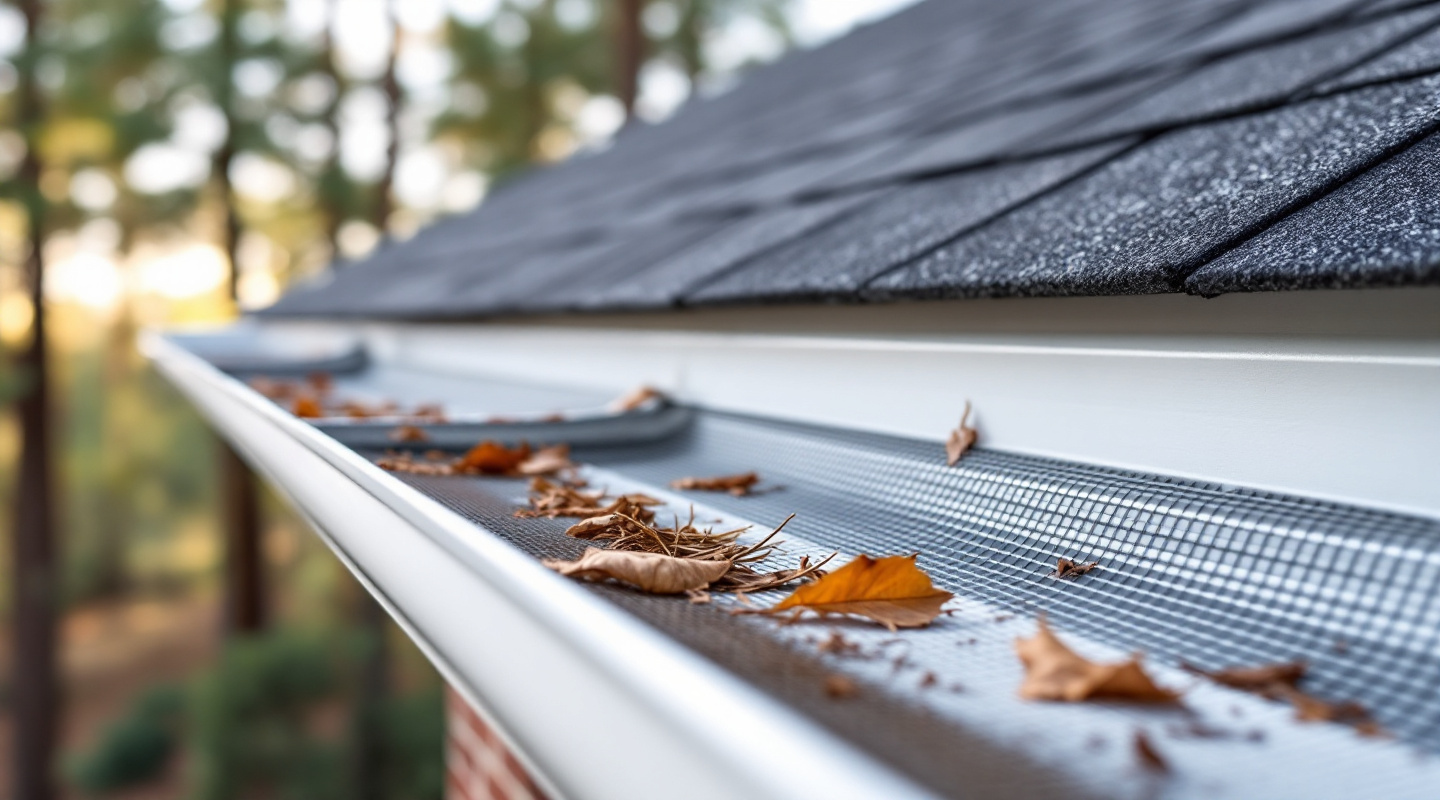
Gutter guards sit on top of your gutters and filter out debris before it can accumulate inside. The mechanism varies by product type — some use micro-mesh screens, some use surface tension to pull water over a curved nose, some use foam inserts or brush systems. Each approach has a different failure mode, and that matters a lot when you’re surrounded by pine trees.
Micro-mesh systems, like LeafBlaster gutter guards, are widely considered the most effective for needle-heavy environments. The mesh openings are small enough to catch pine needles while still allowing water to pass through at a reasonable rate. That’s a meaningful distinction in a neighborhood with mature loblolly or long-leaf pines, where traditional open gutters can pack solid with needles after a single windy week.
The Maintenance Myth
Contractors who are being straight with you will say this: gutter guards reduce maintenance, they don’t eliminate it. Pollen in particular — and Aiken gets some serious pollen loads in spring — can cake onto micro-mesh surfaces and slow water flow. Most homeowners with quality gutter guards go from cleaning twice a year to once every year or two. That’s a real improvement, but it’s not the same as never thinking about your gutters again.
Roof maintenance for homeowners often gets treated as a set-it-and-forget-it checklist, and gutter guards feed into that assumption. The smarter approach is to think of them as a maintenance reducer, not a maintenance eliminator.
The Real Costs Across Aiken Homes
Installation Price Ranges
Gutter guard installation in Aiken typically runs between $8 and $30 per linear foot, depending on the product and the complexity of your roofline. On an average single-story home with roughly 150–180 linear feet of gutters, you’re looking at a total investment somewhere in the $1,200–$5,400 range. Homes with steep pitches, multiple stories, or complex valley work will run toward the higher end.
LeafBlaster gutter guards fall in the mid-to-upper portion of that range — generally $15–$25 per linear foot installed. For most Aiken homes, that works out to $2,200–$4,500 total. That’s not pocket change, but compare it to hiring a gutter cleaning service twice a year at $150–$300 per visit, and the math starts making sense over a five-to-seven year window.
What Changes the Equation
Two things dramatically affect whether the investment pays off: tree coverage and gutter condition at time of installation. A home with minimal tree overhang on a cleared lot may never clean gutters frequently enough to justify the cost. But a home under a canopy of oaks and pines — which describes a large percentage of older Aiken neighborhoods — is a different story entirely.
Gutter condition matters because guards installed on gutters with existing slope problems, rust spots, or improper pitch will still perform poorly. Any good installer should assess your existing gutters before adding guards. Pairing gutter installation and roofing or gutter work together often reduces the overall cost, since the crew is already mobilized and on-site.
How Aiken’s Climate Creates Specific Challenges
The Pine Needle Problem
This is the detail that separates a generic gutter guard article from an honest regional one. Aiken and the surrounding CSRA have a dense population of long-leaf and loblolly pines, and pine needles are genuinely one of the hardest debris types for gutter guards to handle. They’re thin enough to slip through lower-quality mesh openings, they mat together in ways that block surface-tension systems, and they break into small fragments that sneak past foam and brush inserts.
Micro-mesh systems with openings smaller than 50 microns perform noticeably better with pine needles than any other guard type. This is why we consistently see LeafBlaster gutter guards recommended for wooded properties in this region — the mesh specification is designed for exactly this kind of debris load.
Summer Storms and Heavy Rain Events
The CSRA averages over 45 inches of rain annually, and a significant portion of that arrives in intense summer thunderstorms. A clogged gutter during a two-inch-per-hour downpour isn’t just an overflow problem — it’s a fascia problem, a foundation problem, and potentially a crawlspace moisture problem. Gutter guards that keep debris out between storm events reduce the risk of that cascade significantly.
One thing that surprises many homeowners: guards can actually cause water overshoot in extremely heavy rain if the mesh becomes surface-loaded with debris. This isn’t a product failure — it’s a maintenance signal. If your guards are overshoot-prone during storms, a quick rinse of the mesh surface usually resolves it.
Pollen Season Is a Real Variable
Aiken’s spring pollen season runs roughly February through April, and the volume is genuinely significant. Fine pine pollen can form a paste over micro-mesh surfaces when it gets wet. This doesn’t cause the same blockage risks as leaf accumulation, but it does slow drainage rates temporarily. A light rinse with a garden hose from the ground usually clears it without a ladder. That’s still far less work than digging out packed gutters by hand.
Which Homes See the Best Return
High-Canopy Properties
If your home sits under established tree coverage — especially oaks, sweetgums, or pines — gutter guards are almost always worth the investment. These are the homes where gutters pack full in a single season and where wood fascia and soffits take a beating from standing water. Over a ten-year window, the guard system typically pays for itself in avoided cleaning costs and prevented repair work.
For a deeper look at how this calculus plays out across different CSRA property types, the article Gutter Guards: Are They Worth It for CSRA Homeowners? covers the regional specifics in detail.
Homes Where Guards Add Less Value
A newer home on a cleared lot with minimal tree overhang probably doesn’t need gutter guards. If you’re cleaning your gutters once a year and spending under $200 to do it, the ROI math on a $3,000 guard system is weak. Similarly, if your existing gutters are undersized or poorly pitched, guards won’t fix drainage problems — they’ll just change what’s causing them.
The honest answer is that gutter guards are a solution for a specific problem. If that problem is real at your address, they work well. If it isn’t, they’re an expensive answer to a question you weren’t really asking.
Selecting the Right System and Installer
What to Ask Before You Commit
Product quality varies enormously in the gutter guard market. Ask installers about mesh opening size (smaller is better for pine needle environments), frame material (aluminum holds up far better than plastic in South Carolina heat), and whether the system is attached to the gutter or to the roof deck. Systems that screw into roof shingles can void roofing warranties — that’s a detail many homeowners don’t discover until after installation.
- Verify that the installer is licensed and insured in South Carolina — ask for the license number and check it with the SC Contractor’s Licensing Board.
- Ask whether installation requires lifting shingles, and if so, get confirmation in writing that any roofing warranty coverage is preserved.
Pairing Guards with a Roof Assessment
Roof maintenance for homeowners works best as a system, not a series of isolated repairs. If your gutters are being serviced anyway, that’s the right time to have your roof inspected — especially the fascia, soffit, and drip edge, which interact directly with gutter performance. Hixons Roofing regularly identifies minor fascia damage during gutter installation and roofing assessments that would have become expensive repairs within a year or two if left unaddressed.
A competent roofing contractor will tell you if your existing gutter pitch is off, if your downspout count is inadequate for your roof square footage, or if there’s existing water damage that guards alone won’t solve. That kind of integrated assessment is worth more than the cheapest guard price you can find.
So, Are They Worth It for Your Home?
For most Aiken homeowners with any significant tree coverage, quality gutter guards deliver a genuine return — fewer cleaning visits, better water management during heavy rains, and reduced risk of the rot and water intrusion that follow chronically clogged gutters. The key word is quality: a cheap foam insert system will disappoint you, but a properly installed micro-mesh system matched to your debris type is a different experience entirely.
Go in with realistic expectations. Plan on a light maintenance pass every year or two. Make sure your gutters are in good shape before you add guards on top of them. And choose a product designed for the specific debris your trees produce — not just whatever the installer happens to stock.
Written by the Hixons Roofing team — roofing and gutter specialists serving Aiken and the CSRA with hands-on experience across hundreds of residential installations.
To get an honest assessment of whether gutter guards make sense for your specific home and tree coverage, reach out to Hixons Roofing at hixonsroofing.com to schedule a free consultation.