
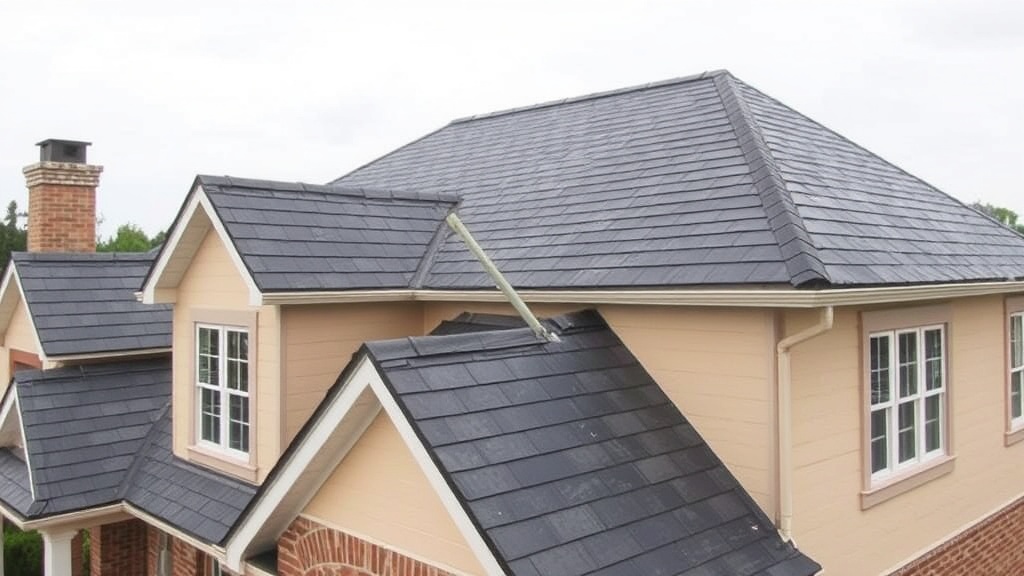
The Roof That Could Outlive Your Mortgage — Or Break Your Budget
A genuine slate roof installed on a properly prepared structure can last 100 to 150 years. That’s not a sales pitch — it’s documented architectural history. Some slate roofs on homes built in the early 1900s are still watertight today.
But here’s what that longevity doesn’t tell you: slate roofing weighs anywhere from 800 to 1,500 pounds per square (a roofing “square” equals 100 square feet). Many older homes in South Carolina — particularly the historic Lowcountry farmhouses and 1960s-era ranch homes common in Aiken County — were never engineered to carry that load. Installing slate on the wrong structure doesn’t extend a home’s life. It stresses it.
That structural reality is why synthetic slate roofing has grown from a niche product into a serious premium option. Before you decide which direction makes sense, you need to understand both sides with real numbers, not just marketing claims.
What Traditional Slate Roofing Actually Costs in South Carolina
Material and Installation Costs
Natural slate is quarried stone — primarily from Vermont, Virginia, and imported sources in Spain and Brazil. Material costs alone typically run $600 to $1,500 per square depending on grade and origin. Installation labor adds another $300 to $600 per square, because slate requires specialized flashing techniques, custom copper nails, and a roofer who understands how stone behaves differently than shingles in heat and cold cycles.
For a standard 2,000-square-foot South Carolina home with a moderately pitched roof — roughly 22 to 25 squares of roofing surface — a natural slate installation commonly lands between $22,000 and $45,000. Premium Spanish slate or thick Vermont black slate can push a mid-size project past $60,000.
The Hidden Structural Cost Nobody Mentions
Most roofing articles stop at the material and labor quote. They don’t mention the structural assessment that responsible contractors require before touching a slate project.
If your home was built after 1980, there’s a reasonable chance the roof framing wasn’t engineered for slate weight. A structural engineer’s evaluation typically costs $400 to $900, and reinforcement work — sistering rafters, adding ridge beam support — can add $3,000 to $8,000 to the project before a single slate tile is installed. For a historic home in Charleston or Summerville that already has a deteriorating slate roof being replaced in-kind, this is often a non-issue. For a 1990s subdivision home considering slate as an upgrade, it changes the math considerably.
How Synthetic Slate Roofing Closes the Gap
Weight, Cost, and Realistic Lifespan
Synthetic slate products — primarily manufactured from recycled rubber, polymer composites, or fiber cement — typically weigh between 175 and 300 pounds per square. That’s roughly one-quarter to one-third the weight of natural slate, which means most standard residential framing can handle it without any structural modifications.
Installed cost for quality synthetic slate in South Carolina generally runs $400 to $800 per square, all-in. For that same 2,000-square-foot home, a complete synthetic slate installation typically lands in the $9,000 to $18,000 range — significantly less than natural slate, and more than standard asphalt shingles, which makes it a true mid-premium option.
Lifespan is where buyers need to pay close attention. Premium synthetic slate products from established manufacturers carry warranties of 40 to 50 years. Real-world performance data suggests they hold up well in most climates, though few products have been in the field long enough to fully validate a 50-year claim. Natural slate, by contrast, has a 150-year performance record you can literally walk through in neighborhoods across the American South.
South Carolina’s Climate Changes the Equation
South Carolina’s humid subtropical climate is genuinely brutal on roofing materials. The CSRA and Lowcountry see summer temperatures that regularly push 95°F to 100°F, combined with humidity that rarely drops below 60 percent. That combination drives thermal expansion and contraction cycles that stress roofing fasteners and field-cut edges — particularly on synthetic products.
Natural slate handles thermal cycling exceptionally well because stone doesn’t expand and contract the way polymer composites do. On south-facing roof planes in Augusta or Columbia, synthetic slate panels can experience temperature swings of 80°F or more between a winter morning and a summer afternoon. Lower-end synthetic slate products sometimes show edge cracking or color fading within 15 years under those conditions. Product selection matters enormously — not all synthetic slate is engineered equally, and the difference between a 20-year performer and a 50-year performer often comes down to the UV inhibitors and the rubber-to-filler ratio in the composite formula.
Where Natural Slate Roofing Clearly Wins
Historic Homes and Preservation Requirements
If your home is listed on a historic registry or located in a historic district — think downtown Charleston, parts of Aiken’s historic core, or older Summerville neighborhoods — local architectural review boards may require material authenticity. Synthetic slate, no matter how convincing it looks from the street, typically won’t satisfy a preservation covenant that specifies natural slate. In these cases, the choice isn’t really a choice at all.
Beyond regulatory requirements, a genuine slate roof adds measurable resale value to a historic property in a way synthetic products don’t replicate. Real estate appraisers and buyers familiar with historic homes in the Lowcountry specifically look for original or period-appropriate materials. A synthetic slate roof on a registered historic home can actually be a detractor rather than an asset at resale.
The 100-Year Investment Argument
If you plan to stay in your home for decades and your structure can support the weight, natural slate is the only roofing material that genuinely eliminates the re-roofing conversation for the next two or three generations. When you factor in how much does a new roof cost over a 100-year period — potentially three or four asphalt replacement cycles, or two synthetic slate cycles — natural slate’s higher upfront cost becomes more defensible on a per-year basis.
A natural slate roof installed for $35,000 amortized over 120 years costs roughly $290 per year. A synthetic slate roof at $13,000 amortized over 45 years costs about $290 per year, too — but then you’re re-roofing again in your late 70s or passing that cost to heirs. The math is closer than it looks, which is exactly why this decision deserves serious analysis rather than a quick answer based on sticker price.
Where Synthetic Slate Roofing Makes More Sense
New Construction and Post-1975 Homes
For homes built without slate-weight framing, synthetic slate delivers most of the aesthetic appeal at a fraction of the structural risk and cost. It installs with standard roofing fasteners, cuts with conventional tools, and doesn’t require the specialized labor pool that natural slate demands — which matters in markets like Augusta, where certified slate installers are genuinely scarce.
From a roof maintenance for homeowners standpoint, synthetic slate is also more forgiving. A cracked or missing natural slate tile requires sourcing a matching tile from the same quarry lot — sometimes impossible if that quarry closed decades ago. A cracked synthetic tile is a call to a local roofing supplier and a straightforward repair.
Storm Damage Recovery Scenarios
South Carolina’s coastal and midland counties see tropical storm activity most years. Natural slate handles wind reasonably well when properly installed, but hail is a different story — large hail can crack or chip slate, and insurance claims on natural slate roofs are notoriously expensive to settle because of material matching requirements. Synthetic slate products with Class 4 impact ratings (the highest available) often qualify for insurance premium discounts and replace cleanly without matching complications.
Homeowners considering roofing contractor financing options for a premium upgrade will also find that the lower overall project cost of synthetic slate makes financing more accessible and less stressful to service over a 5 to 10-year loan term.
Installation Quality Matters More Than the Material You Choose
The Underlayment Problem Nobody Talks About
Across projects handled throughout the CSRA and South Carolina Lowcountry, one pattern appears consistently: failed premium roofs that used quality material but had compromised underlayment installation. Both natural and synthetic slate require a high-temperature, self-adhering underlayment in valleys and at eave edges — not standard felt paper. In South Carolina’s climate, inadequate underlayment is responsible for a significant share of leak callbacks on otherwise well-installed premium roofs.
Proper flashing at chimneys, skylights, and dormers is equally important. Slate roofing demands copper or stainless steel flashing — galvanized sheet metal reacts with slate’s mineral content and fails prematurely. That detail alone separates a contractor who knows slate from one who doesn’t.
Pairing Your Roof with Gutters That Can Handle the Load
A premium roof investment should include a gutter system rated for the runoff capacity your new roof generates. Slate’s smooth surface — both natural and synthetic — sheds water faster than textured asphalt shingles, which means undersized gutters overflow during heavy rain events and channel water against your foundation. Gutter installation and roofing should be evaluated together, not as separate line items, to protect the full investment you’re making in your home’s envelope.
Making the Call for Your South Carolina Home
Natural slate wins on longevity, historic authenticity, and long-term value on structurally appropriate homes. Synthetic slate wins on cost, weight compatibility, repairability, and impact resistance — making it the practical premium choice for most South Carolina homeowners who want a roof that stands apart from asphalt without the structural and financial complexity of stone.
The right answer depends on your home’s age, your framing capacity, your neighborhood’s architectural context, and how long you plan to own the property. Getting a proper structural assessment before committing to either option isn’t optional — it’s the step that determines whether your investment performs the way you expect.
Hixons Roofing has been evaluating, installing, and repairing premium roofing systems across South Carolina and the CSRA for years, and we’ve seen both materials succeed brilliantly and fail predictably based on how well the installation matched the home’s actual needs.
Written by the Hixons Roofing team — experienced roofing specialists serving South Carolina and the Augusta area with slate roofing, synthetic slate installations, metal roofing, and full residential roof replacements.
Schedule your premium roofing consultation with Hixons Roofing at hixonsroofing.com.