
Your air conditioner runs constantly. Your energy bills keep climbing. And when summer hits the Lowcountry or Augusta area with that brutal 95-degree heat, your home feels like it never quite cools down—no matter how low you crank the thermostat.
Here’s what most homeowners don’t realize: the problem isn’t your AC unit. It’s happening 20 feet above your head, in an attic that’s turned into a 150-degree oven because your roof ventilation system isn’t doing its job.
That superheated attic is radiating heat down into your living spaces all day and all night, forcing your cooling system to battle an enemy it can never defeat. The result? Energy bills that spike $60-$120 per month during summer, an AC system that burns out years early, and a roof that’s literally cooking itself from the inside out.
The frustrating part? Most people don’t discover their ventilation problem until they’re already thousands of dollars deep in damage.
The Hidden Cost of Poor Attic Ventilation
Walk into most attics in South Carolina or Georgia during July, and you’ll understand why proper airflow matters. Without adequate roof ventilation, attic temperatures routinely hit 140-160°F—hot enough to make your insulation less effective and turn your ceiling into a radiant heater.
That extreme heat doesn’t stay contained. It conducts through your ceiling, even with insulation, raising your indoor temperature by 5-8 degrees. Your thermostat registers 78°F, but it feels warmer. So you lower the setting. Your AC runs longer cycles. Your compressor works harder. And your electric bill climbs.
The Real Numbers Behind Ventilation Problems
A poorly ventilated 2,000-square-foot home in Charleston or Columbia can see cooling costs increase by 20-40% during peak summer months. That’s an extra $480-$960 per year for many homeowners—money that’s literally evaporating into your attic.
But energy waste is just the beginning. That trapped heat accelerates shingle deterioration, turning a roof that should last 25 years into one that needs replacement at 15. When you’re looking at how much does a new roof cost—typically $8,000-$15,000 for an asphalt shingle roof in our region—premature failure becomes an expensive problem.
Here’s the insider detail most people miss: your warranty might not cover it. Many shingle manufacturers require adequate ventilation as a warranty condition. Without proper airflow, you could be voiding coverage worth thousands.
How Roof Ventilation Actually Works (And Why Most Homes Get It Wrong)
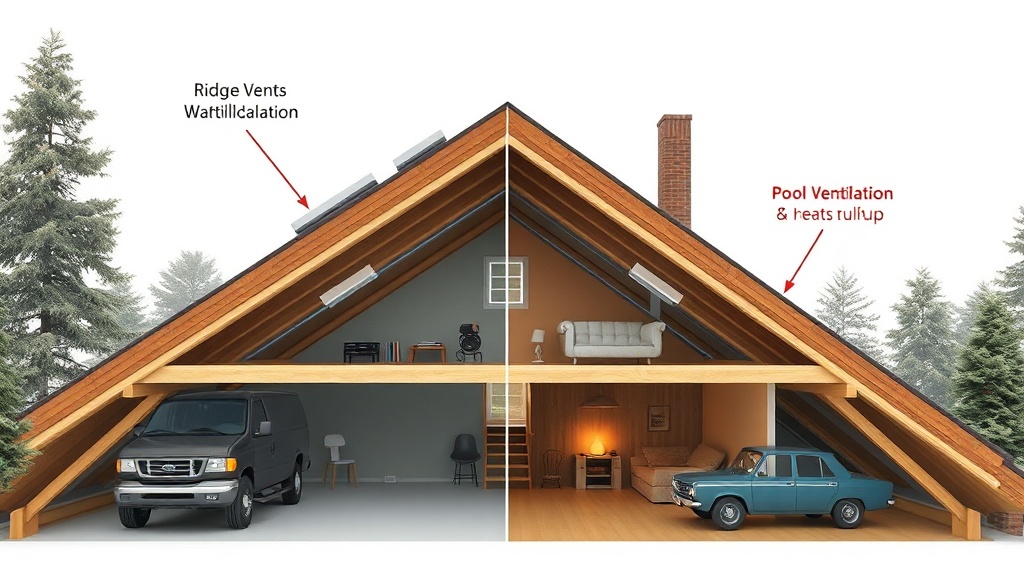
Proper attic ventilation isn’t complicated in theory—it’s a simple intake and exhaust system that creates continuous airflow. Cool outside air enters through soffit vents at your roof’s edges, flows upward through the attic space, and exits through ridge vents or other exhaust points at the peak.
This constant air movement does two critical things: it expels superheated air before it can radiate into your home, and it prevents moisture buildup that can rot decking and ruin insulation.
The problem? Most homes have one of three ventilation failures happening right now.
Blocked Soffit Vents
Your intake vents run along the underside of your roof overhang, but they’re easily blocked by insulation that’s been blown too close to the eaves, by debris, or by paint applied during an exterior refresh. When intake air can’t enter, the whole system fails—like trying to breathe through a straw with one end covered.
Insufficient Exhaust Capacity
Building codes in Georgia and South Carolina require a specific ventilation ratio: one square foot of ventilation for every 150 square feet of attic space (or 1:300 if you have a vapor barrier). Many older homes and even some newer builds fall short, especially if they’re relying solely on small gable vents instead of continuous ridge ventilation.
Mixed Ventilation Systems
Here’s what roofing contractors won’t always tell you: combining different exhaust methods—say, powered attic fans with ridge vents—can actually reduce efficiency. The fan pulls air from the path of least resistance, which might be your ridge vent instead of your soffit vents, short-circuiting the airflow pattern you need.
Signs Your Roof Ventilation Is Failing Right Now
Most ventilation problems announce themselves long before you get the shocking energy bill or discover roof damage. You just need to know what to look for.
Your Upstairs Is Always Hotter
A 3-5 degree temperature difference between floors is normal. But if your second floor feels 8-10 degrees warmer and never cools down even at night, you’re likely dealing with heat radiating from an overheated attic. The Hixons Roofing team sees this constantly in Mount Pleasant and Summerville homes, especially in two-story colonials with inadequate ridge venting.
Ice Dams Form In Winter (Yes, Even Here)
We don’t get snow often in the Lowcountry or Augusta, but when we do, watch your roof. Ice dams—ridges of ice forming at the roof edge—signal that your attic is warm enough to melt snow, which then refreezes at the colder eave. That’s a ventilation red flag showing heat escape even in winter.
Visible Shingle Damage
Take a look at your roof from the street. Do you see shingles that are curling at the edges, with corners lifting up? Discoloration or dark streaks beyond normal algae growth? These are signs of roof damage caused by excessive attic heat literally cooking your shingles from underneath. In South Carolina’s humid climate, this deterioration accelerates fast.
Moisture Or Mold In The Attic
Poor ventilation doesn’t just trap heat—it traps moisture. During summer, your AC cools your living space, but humid air in an unventilated attic condenses on cooler surfaces like roofing nails penetrating from outside. You’ll see frost on nail tips in winter (rare but possible here) or moisture stains and mold growth on decking and rafters.
Your Energy Bills Keep Climbing
If your electricity costs are increasing year over year despite similar usage patterns, your cooling system is working harder. Before you replace your AC, check your attic. A $1,500 ventilation fix might save you from a $6,000 HVAC replacement.
Ridge Vents vs. Soffit Vents vs. Other Systems: What Works In The Southeast
Not all ventilation systems perform equally in Georgia and South Carolina’s climate. Our combination of extreme heat, high humidity, and occasional severe weather demands specific solutions.
Ridge Vents: The Gold Standard
Continuous ridge vents running the entire length of your roof peak provide consistent exhaust capacity without the aesthetic intrusion of box vents or turbines. When paired with adequate soffit intake, ridge vents create optimal airflow using natural convection—no moving parts to break, no electricity to run.
They’re particularly effective on asphalt shingle and metal roofing installations, which represent most homes in Aiken, Charleston, and Columbia. The key is proper installation: the ridge needs to be cut back appropriately, and the vent must be covered with ridge cap shingles that don’t restrict airflow.
Soffit Vents: The Essential Intake
Your ridge vents can’t exhaust air if there’s no intake feeding them. Continuous soffit vents—perforated panels running the length of your eaves—provide the most consistent intake. They outperform individual rectangular vents spaced every few feet because they eliminate dead zones where air can’t enter.
The installation detail that matters: your insulation needs to stop 3-4 inches from the eaves, and baffles should be installed to maintain a clear airflow channel from soffit to ridge. Without baffles, blown insulation will eventually migrate and block your intake.
What About Powered Attic Fans?
Electrically powered fans seem like an obvious solution—more airflow must be better, right? Not necessarily. While fans can move air, they consume electricity (reducing your energy savings), require maintenance, and can actually pull conditioned air from your living space through ceiling penetrations if your attic isn’t perfectly sealed.
For most homes in our service area, a properly designed passive ventilation system using ridge and soffit vents provides better long-term value without ongoing operating costs.
Solar-Powered Options
Solar attic fans offer a middle ground—supplemental airflow without electricity costs. They work well as additions to existing ventilation in particularly problematic attics, but they shouldn’t be your primary system. And if you’re already considering solar technology for your home, solar shingles might be worth exploring as a comprehensive energy solution.
Climate-Specific Requirements For South Carolina And Georgia
Building codes establish minimum ventilation standards, but minimums rarely deliver optimal performance in our region’s climate. Here’s what actually works for homes from North Charleston to Beech Island.
Dealing With Extreme Heat
The Southeast sees longer cooling seasons than most of the country—we’re running AC from April through October in many years. That extended heat exposure means your attic spends 6-7 months as a thermal liability. You need ventilation capacity that exceeds code minimums, typically achieving a 1:150 ratio (one square foot of net free ventilation area per 150 square feet of attic space) with balanced intake and exhaust.
Managing High Humidity
Coastal areas like Charleston, Mount Pleasant, and Summerville face year-round humidity that makes moisture management critical. Your ventilation system needs to move enough air to prevent condensation while avoiding over-ventilation that can pull humid outdoor air into the attic during summer.
The solution involves more than just ventilation—it requires an integrated approach with proper insulation, vapor barriers, and sealed penetrations. The roofing professionals at Hixons Roofing evaluate all these factors together because fixing one without addressing the others leaves problems unsolved.
Storm Considerations
Our region also deals with severe weather: tropical systems bringing wind-driven rain, occasional hurricanes, and intense thunderstorms. Your ventilation system needs to move air without creating entry points for water. That means properly installed ridge vents with weather-resistant baffles and soffit vents with screening that prevents insect infiltration.
Fixing Your Ventilation Problem: What Actually Works
Once you’ve identified poor roof ventilation as your energy bill culprit, correction usually involves one of three approaches, depending on what your home needs.
Adding Ridge Ventilation
If your home relies on inadequate gable vents or a few box vents, adding a continuous ridge vent system typically delivers the most dramatic improvement. This requires cutting back the roof decking along the ridge, installing the vent, and capping it with ridge shingles. When done correctly, it’s virtually invisible from the ground while providing maximum exhaust capacity.
The investment typically ranges from $800-$1,800 depending on roof size and complexity—a fraction of what you’ll save in energy costs over the system’s lifetime.
Upgrading Soffit Intake
If you have ridge vents but they’re not performing, the problem is often insufficient intake. Upgrading to continuous soffit vents and installing baffles to maintain clear airflow channels can transform your system’s performance.
This work often coordinates with gutter installation or gutter repair projects, since both involve work on your roof’s edges. Addressing both at once saves on labor costs and ensures integrated weatherproofing.
Complete Attic Remediation
Homes with multiple issues—blocked vents, inadequate insulation, moisture damage, or outdated systems—benefit from comprehensive attic renovation. This addresses ventilation alongside insulation upgrades, air sealing, and damage repair.
While more extensive, this approach delivers the greatest energy savings and often makes sense when you’re already planning roof replacement or discovering ventilation problems alongside other signs of roof damage.
What You Should Do Next
Your attic might be silently inflating your energy bills right now. Every month you wait costs you money while potentially shortening your roof’s lifespan by years.
Start with a simple inspection. On a hot afternoon, carefully access your attic (if it’s safe to do so) and check the temperature—if you can’t tolerate staying there for more than 30 seconds, your ventilation isn’t working. Look at your soffit vents from outside to confirm they’re not blocked by paint or debris. And examine your roof peak to see what exhaust ventilation you currently have.
If you’re seeing warning signs—uncomfortable upstairs rooms, high energy bills, curling shingles, or attic moisture—it’s time for a professional evaluation. The challenge is that ventilation problems often intertwine with insulation issues, roof damage, and structural concerns that require trained eyes to diagnose properly.
Hixons Roofing provides comprehensive roof ventilation assessments throughout South Carolina and Georgia, from Charleston to Augusta and everywhere in between. We’ll evaluate your complete attic environment, identify what’s driving your energy costs up, and provide specific solutions with transparent pricing.
Most ventilation fixes deliver ROI within 2-3 years through energy savings alone—not counting the extended roof life and improved home comfort you’ll gain. And unlike some improvements that you’ll never notice, proper ventilation makes your home measurably more comfortable from day one.
Don’t let a fixable ventilation problem cost you thousands in wasted energy and premature roof replacement. Contact the team at Hixons Roofing today to schedule your ventilation assessment. Your attic—and your energy bill—will thank you.