
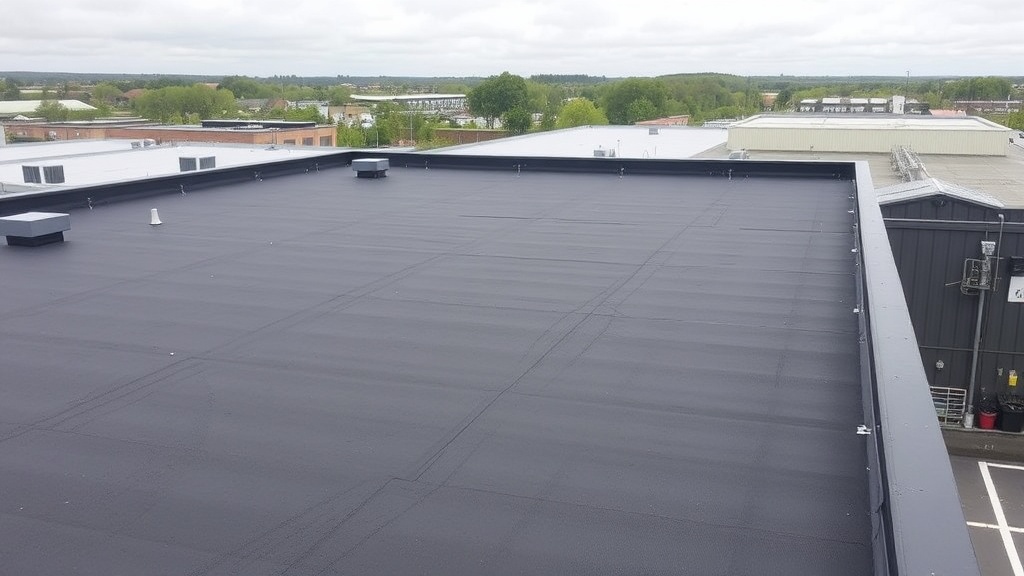
Two Roofs, One Georgia Summer — Only One Wins
A strip mall owner in Augusta watched his energy bills climb every July. The building had a 12-year-old EPDM roof — still technically intact, no active leaks — but the black membrane was absorbing heat like a cast iron skillet. His HVAC units were fighting the roof, not just the weather. When a competitor across town retrofitted their building with TPO, their cooling costs dropped noticeably within two billing cycles.
That’s not a fluke. It’s one of the most practical differences between these two systems, and it almost never comes up in the standard TPO vs. EPDM comparison articles you’ll find online. For anyone managing a commercial flat roof in Augusta, GA, the material choice matters far more than most property owners realize — not just at installation, but every summer for the next two decades.
This breakdown covers what each system actually does under CSRA conditions, what repairs cost when things go wrong, and how to know when a patch job is no longer enough.
What TPO and EPDM Actually Are (Without the Sales Pitch)
TPO: The White Membrane Built for Heat Reflection
Thermoplastic Polyolefin — TPO — is a single-ply membrane that’s typically white or light gray. That color isn’t cosmetic. It’s the entire performance strategy. TPO reflects solar radiation rather than absorbing it, which matters enormously in Augusta where summer surface temperatures on a dark roof can exceed 170°F on a clear afternoon.
TPO seams are heat-welded, meaning a hot-air tool fuses the overlapping sheets into a single bond. Done correctly, those seams are actually stronger than the membrane itself. Done incorrectly — by someone who rushed the weld temperature or worked in direct afternoon sun without allowing for thermal expansion — the seams peel within a few years and become your next roof leak repair call.
Manufacturer spec sheets list typical TPO membrane thickness at 45 to 80 mil. The 60-mil and 80-mil options cost more upfront but hold up meaningfully better against foot traffic and punctures from HVAC equipment servicing.
EPDM: The Durable Standard That’s Been Around Forever
Ethylene Propylene Diene Monomer — EPDM — is the black rubber membrane you’ve seen on commercial buildings for decades. It’s been a flat-roofing standard since the 1960s, and for good reason: it’s flexible, resistant to UV degradation, and handles freeze-thaw cycles well.
That freeze-thaw resilience is less relevant in Augusta than it would be in, say, Chicago. What matters more here is that black EPDM absorbs heat aggressively. Studies from the Department of Energy’s Oak Ridge National Laboratory have documented surface temperature differences of 50°F to 70°F between black EPDM and white reflective membranes under identical conditions. For a building with older HVAC equipment or high cooling loads, that absorbed heat translates directly into operating costs.
EPDM seams are bonded with adhesive or tape — not welded — which is historically its most common failure point. Quality lap sealant and proper installation extend seam life considerably, but adhesive bonds do degrade over time in ways that heat-welded TPO seams typically don’t.
How Augusta’s Climate Punishes Flat Roofs Differently
The Heat Cycling Problem
Augusta averages over 50 days per year above 90°F, and the rooftop temperature is always significantly higher than the air temperature. Every day the sun rises and sets, your flat roof goes through a thermal expansion-contraction cycle. Over years, this stress concentrates at seams, flashings, and penetrations — the same spots where leaks almost always originate.
TPO handles this cycle well because the membrane itself has some thermal movement built into its design, and the welded seams move with it. EPDM’s adhesive seams are more vulnerable to repeated expansion stress, particularly on older installations where the adhesive has already begun to stiffen.
Ponding Water After Summer Storms
Augusta’s storm season brings fast, heavy rainfall. If a commercial flat roof has any drainage issue — a clogged drain, a low spot from deck deflection, improper slope — water ponds. Both TPO and EPDM can tolerate short-term ponding, but sustained standing water degrades adhesives faster than almost anything else. A drain that backs up twice a summer will shorten either membrane’s lifespan by years.
One thing contractors won’t always tell you upfront: ponding water is almost never just a roofing material problem. It’s a drainage and deck problem. Repairing or replacing the membrane without addressing the underlying drainage issue means you’ll be back on that roof within three to five years.
Real Repair Costs for Commercial Flat Roofs in Augusta
What a Typical Repair Actually Runs
For a localized repair on a TPO roof — a seam separation, a small puncture near an HVAC curb, or flashing that’s pulled away from a parapet wall — expect to pay in the range of $400 to $900 depending on scope and access. Those numbers assume a qualified crew using compatible materials; patching a TPO membrane with the wrong product voids most manufacturer warranties and accelerates failure.
EPDM repairs in the same category typically run $350 to $750. The materials cost less, and the repair process is simpler — clean the area, apply primer, bond a patch with lap cement or seam tape. The lower entry cost is real, but it comes with a caveat: EPDM repairs on aging adhesive-seam roofs often reveal additional seam failures nearby. What looks like a single repair job sometimes becomes three.
Emergency situations — an active interior leak during a storm, water coming through a ceiling in an occupied space — push those numbers higher. Emergency roof repair often involves after-hours labor, temporary tarping, and fast-track scheduling that commands a premium. Budgeting $1,200 to $2,500 for a genuine emergency repair on a mid-size commercial building is a reasonable planning figure.
When Repairs Stop Making Sense
A flat roof that needs more than two significant repairs in a five-year window is telling you something. The math shifts when cumulative repair costs exceed 25 to 30 percent of a full replacement cost — at that point, you’re spending real money to extend a system that’s already in decline.
Full TPO replacement on a 5,000 to 10,000 square foot commercial flat roof in the Augusta area typically runs in the $4.50 to $7.50 per square foot range, depending on deck condition, insulation requirements, and number of penetrations. EPDM replacement comes in slightly lower on materials but not dramatically so. The labor cost is the dominant factor at that scale either way.
TPO vs. EPDM Augusta: Lifespan Expectations Under Real Conditions
Both systems carry manufacturer warranties in the 15 to 25 year range when properly installed and maintained. Real-world lifespan in the CSRA, based on what shows up on commercial roofing inspection reports, tends to track closer to 15 to 20 years for TPO and 12 to 18 years for EPDM — with significant variation based on installation quality and maintenance history.
The single biggest lifespan killer for both systems isn’t the material itself — it’s deferred maintenance. A twice-yearly roof inspection that catches a failing flashing or a seam that’s starting to lift costs a few hundred dollars. Ignoring that same issue for two years often means water has infiltrated the insulation layer, which can double or triple the repair scope.
Hixons Roofing has been working on commercial flat roofs across Augusta and the broader CSRA for years, and the pattern is consistent: buildings with active maintenance programs extend membrane life by four to six years compared to buildings that only call when there’s an interior leak. That gap represents real money.
Making the Right Call for Your Building
Choose TPO If…
Your building has high cooling loads, you’re in a location with significant sun exposure, or you’re doing a full replacement and want the best long-term energy performance. TPO is also the better choice if foot traffic from HVAC technicians is regular — the thicker mil options handle puncture stress better than comparable EPDM.
Choose EPDM If…
You’re repairing or overlaying an existing EPDM system and a full tear-off isn’t in the budget. Compatibility matters: putting a new EPDM layer over existing EPDM is straightforward. You’re also working with a simpler repair process if you need to address isolated failures yourself between professional visits, though any significant repair on a commercial property should involve a licensed contractor.
When to Repair vs. Replace
Repairs make strong financial sense when the membrane is under 12 years old, failures are isolated to specific areas (not distributed across the whole roof), and the underlying deck and insulation are sound. Once a roof is past 15 years with widespread seam failures or insulation that’s retained moisture, replacement is the more defensible investment — even if the upfront number is harder to approve.
If you’re unsure which category your building falls into, a moisture scan — either infrared or nuclear — can map wet insulation across the entire roof plane without a single core cut. That data takes the guesswork out of the repair-vs-replace decision and gives you a defensible answer for ownership or board approval.
Your commercial flat roof works harder in Augusta than it would almost anywhere else in the country. Choosing the right material and staying ahead of maintenance isn’t just good property management — it’s the difference between a roof that performs for 20 years and one that costs you in chunks every three.
Written by the Hixons Roofing team — commercial and residential roofing specialists serving Augusta, GA and the CSRA with hands-on experience across TPO, EPDM, metal, and shingle systems.
To get a straight assessment on your commercial flat roof’s current condition and the right repair or replacement path forward, schedule an inspection with Hixons Roofing at hixonsroofing.com.